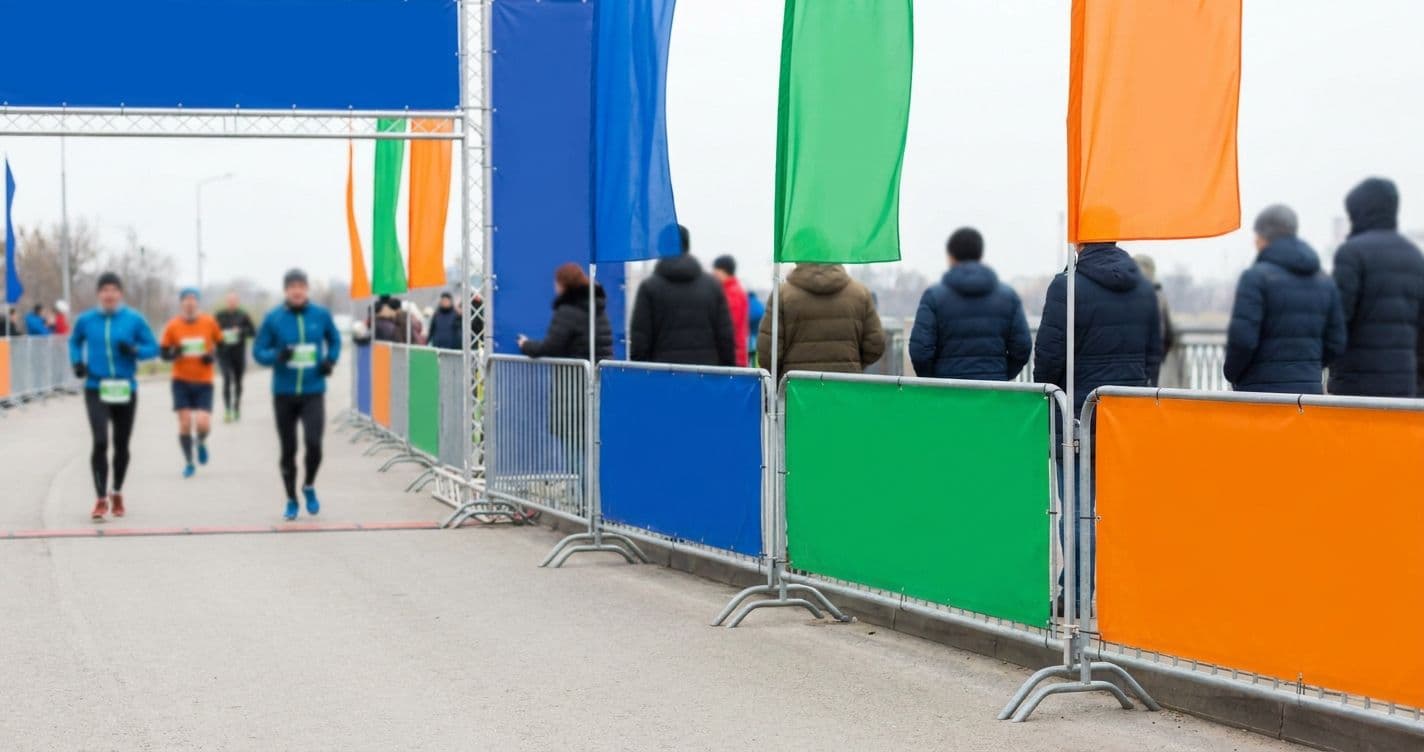
Most sponsorship conversations start with a list of physical things. The finish arch, the start banner, the back of the t-shirt, the expo booth, the stage backdrop. That list runs out quickly, and once it does most organizers start discounting instead of adding inventory.
Meanwhile you are sitting on digital inventory that costs nothing to produce, reaches the same audience more often than any banner, and is far easier to measure. Below are seven event sponsorship package ideas built entirely from assets you already own. The seventh is the one almost nobody sells, and it is probably the most valuable thing on the list.
Why digital sponsorship assets are easier to sell than banners
They are measurable. A sponsor cannot tell you how many people looked at your finish arch. They can tell you exactly how many people opened an email or a page. Measurable inventory survives the sponsor's own internal review, which is usually what kills renewals.
They cost you nothing to produce. A printed banner has a real cost and a lead time. Adding a logo to a page you are already publishing has neither. Every dollar of a digital placement is margin.
They keep working after the event. Physical signage stops earning the moment the course is packed up. A results page or a photo gallery keeps getting opened for weeks, which means you are selling a window of attention rather than a single day.
One caution before the list. Do not bundle these in as free bonuses to close a physical package. Price them as line items. The moment you give a digital placement away, you have taught that sponsor it is worth nothing.
Six digital assets you already own
1. The results page
Every participant checks their result, and most check it more than once. Many share the link with people who were not even at the event. A sponsor logo at the top of the results table, or a short "timing brought to you by" line, is the single easiest digital placement to sell because the intent is so high. Price it as a named presenting slot rather than a logo dump.
2. Confirmation and reminder emails
Registration confirmations, race week instructions, and the post-event thank you are the highest open rate emails you will ever send, usually far above anything a sponsor achieves on their own list. Sell a footer banner or a single sponsor block in the sequence. Because you can report opens and clicks, this is often the placement a sponsor's marketing team likes most.
3. The bib
The bib is technically physical, but its value is now mostly digital. It appears in every photo, every finish line video, and every social post a participant makes. Treat bib space as media inventory rather than print, and price it against the number of photos it will appear in. If you also print a QR code on the bib, you are creating the traffic that makes every other asset on this list more valuable.
4. The check-in or venue wifi screen
If people log into a wifi network or pass through a digital check-in, that screen is a guaranteed full attention impression from every single attendee. Conference organizers underuse this badly. It is one of the few placements where you can honestly promise close to one hundred percent reach of the people in the building.
5. Livestream and social clips
A lower third on a livestream, or a branded end card on the recap clips you post afterwards, reaches an audience much larger than your participant list. Sell the clip series as a package rather than a single post, and report total views across the set. This is the asset that lets a sponsor claim reach beyond your event.
6. The course map, schedule, or agenda screen
People return to a map or an agenda repeatedly, usually right before they make a decision about where to go. A sponsor placed next to a specific aid station, stage, or session track gets genuine context, which is worth more than a generic logo. This is the natural home for a category sponsor who wants to own one part of the experience.
7. The asset most organizers never sell: your photo gallery
Every other asset on this list is something a participant passes through. The photo gallery is different, because people come to it voluntarily, they come back more than once, and they stay a while. They are looking for pictures of themselves, which is close to the most engaged state a human being can be in. Almost no organizer sells this.
The placement itself is straightforward. On a branded event gallery you control the cover image, the colors, the logo, and the sponsor banners. Worth knowing where the attention actually sits: the branding panel stays fixed on screen while a participant scrolls the photo grid, so a sponsor is present for the whole time somebody is hunting for their own pictures. That is a dwell time asset, not a flash impression.
What the volume actually looks like
For a sense of scale, the Valens Victorious gallery holds 8,649 photos across two race days, 5,335 from the main race and 3,314 from the sprint, with roughly 6,200 face recognitions run against them. That is one regional obstacle race, not a major marathon. Open it and time how long you spend before you look away.
How to put a real number in your sponsorship deck
Sponsors do not buy adjectives. They buy numbers. Here is a four step calculation you can run for your own event before you have any gallery data at all. Every figure below is an assumption you should replace with your own, and the point is the method rather than the specific output.
Step 1, start with participants. Take a 1,500 participant race.
Step 2, estimate who opens the gallery. If the QR code is on the bib and the link is in your results email, a conservative planning assumption is around 65 percent. That is roughly 975 people.
Step 3, count visits, not people. Participants typically come back: once on the day, again when the full set is up, and again when they want to send something to a friend. At two visits each that is about 1,950 sessions.
Step 4, convert to branded screen time. Somebody scanning thousands of photos for their own face is not in and out in ten seconds. At a modest four minutes per session, 1,950 sessions is roughly 7,800 minutes, or about 130 hours of continuous sponsor presence.
Now compare that to the finish arch you already sell. Fifteen hundred runners pass under it once and glance for maybe two seconds, which is about 50 minutes of total attention. The gallery, on the same audience, delivers on the order of a hundred times more. That comparison is the slide.
What to charge for it
Resist pricing this on a generic display advertising rate. Those rates assume an audience that is ignoring the page, and your audience is doing the opposite. Price it relative to inventory you already sell. If your finish arch goes for $1,500 and the gallery delivers far more attention to the same people over a longer window, then somewhere between $1,000 and $2,500 for a presenting placement is defensible in year one. Start lower than you think you should, get one sponsor through a full cycle, then use the real numbers to raise it.
A note on honesty, because it protects the renewal. Sell the gallery as a presenting and browsing placement. Do not promise a sponsor logo burned into the photos themselves, and do not promise their brand appears inside the full screen photo viewer. Promise what you can actually deliver, then over deliver on the reporting.
What to report back after the event
The reason most event sponsorships are not renewed is not poor delivery. It is that nobody ever sent the sponsor proof. You do not need a sophisticated dashboard for this. Pull the basic counts you have, gallery visitors, photo views, and downloads, screenshot them, and put them in a one page recap alongside the placement itself.
Send it within a week, while the event is still fresh and before the sponsor's next budget cycle closes. An imperfect report sent quickly beats a perfect one sent in November, every time.
Frequently asked questions
What are digital sponsorship assets?
Any owned digital surface where a sponsor can appear: your results page, your email sequence, your check-in screen, your livestream, your map or agenda, and your photo gallery. They are distinct from physical signage in that they cost nothing to produce, can be measured, and keep delivering after the event finishes.
How much should I charge for a digital sponsorship placement?
Price against inventory you already sell rather than against advertising benchmarks. Work out how much attention the digital placement delivers compared to a physical asset with a known price, then set your number below that ratio for the first cycle. Once you have real numbers from one event, you have the evidence to price properly.
Can a photo gallery really work as a sponsor asset?
It is one of the strongest surfaces you own, because visitors arrive voluntarily, return more than once, and stay while they search for themselves. The practical requirement is that your gallery supports your branding and sponsor placement in the first place. A folder of files on a shared drive cannot be sponsored.
What do sponsors actually want from an event?
Something they can defend internally. That means a specific audience, a number attached to it, and proof after the fact. Exposure on its own is a weak pitch. Exposure with a measurement and a recap report is what gets renewed.
Which digital asset should I sell first?
The results page, because intent is highest and the conversation is easiest. Then the email sequence, because you can report opens and clicks. Then the photo gallery, which needs slightly more explanation but carries the most attention once a sponsor understands it.
See what a sponsored gallery looks like
The easiest way to judge this asset is to behave like a participant. Open the live event gallery, start scrolling, and notice how long the branding stays in front of you. No sign up and no app, which is exactly why participants actually show up.
If you want the gallery to carry your sponsors at your next race or conference, book a demo and we will run the attention math for your event size so you have a number to take into the sponsor conversation.